
Bannock County Republican Central Committee
Proposition 1: What It Actually Does
On November 3, 2026, Idahoans will vote on the “Reproductive Freedom and Privacy Act.” It is a statutory initiative — not a constitutional amendment — and it would rewrite Idaho’s abortion law. The Bannock County Republican Party urges a NO vote. Below is the measure in plain language, our objections to its text, and the official state and national data on maternal and infant health in Idaho — with links to every primary source.
What Proposition 1 Would Do
Official ballot title: “Measure establishing a right to make and carry out reproductive decisions, including a right to abortion up to fetus viability.”
Proposition 1 is a statutory initiative. If a majority votes yes, it becomes Idaho code on the effective date and supersedes conflicting Idaho law, including the Defense of Life Act at Idaho Code § 18-622. Its principal provisions:
- Creates a statutory right to make and carry out reproductive decisions — including abortion, contraception, fertility treatment, miscarriage management, and pregnancy-related care — free of government interference.
- Sets a high bar for any regulation. Government may restrict that right only where the restriction is narrowly tailored to protect the patient’s health by the least restrictive means. That is among the most demanding standards in American law, and existing Idaho safeguards would have to survive it.
- Permits abortion up to viability — a point determined by the treating health care provider’s good-faith professional judgment rather than by a fixed number of weeks written into the statute.
- Permits abortion after viability where the provider judges the patient’s life or health to be at risk, including “serious jeopardy” to health, impairment of a bodily function, or serious dysfunction of an organ or body part.
- Directs courts to construe the measure liberally in favor of reproductive freedom.
- Extends to any licensed health care provider acting within the scope of their license, not physicians alone.
Read it yourself before you vote. We link the full official text in the Sources section below, and we encourage every Bannock County voter to read the measure rather than rely on any campaign’s description of it — including ours.
Idaho Law Today vs. Idaho Law Under Proposition 1
| Current Idaho law (Idaho Code § 18-622) | If Proposition 1 passes | |
|---|---|---|
| General rule | Performing an abortion is a felony punishable by 2 to 5 years imprisonment, with professional license suspension or revocation. | Abortion is a protected right up to viability, with post-viability access where the provider finds a life or health risk. |
| Life of the mother | Excepted where, in the physician’s good-faith medical judgment, the abortion was necessary to prevent the death of the pregnant woman. | Protected, and broadened to include health as well as life. |
| Rape and incest | Excepted only in the first trimester, and only where the crime was reported to law enforcement and a copy of the report was given to the physician beforehand. | No reporting requirement and no first-trimester limit; covered by the general right up to viability. |
| Ectopic and molar pregnancy | Expressly not an “abortion” under the statute; treatment is lawful. | Protected. |
| Who may provide care | Physicians. | Any licensed health care provider acting within their scope of practice. |
| Civil liability | Family members may sue a provider for damages, with statutory damages of at least $20,000. | Displaced as to protected care. |
| Other regulations | Parental involvement, informed consent, waiting periods, and facility standards apply. | Each must independently satisfy the narrow-tailoring and least-restrictive-means test or risk being struck down in court. |
One note on current law. Idaho’s statute is the subject of active federal litigation. On August 13, 2026, U.S. District Judge B. Lynn Winmill enjoined enforcement of the criminal ban where an abortion is needed to protect the pregnant woman’s health. Attorney General Raúl Labrador has said he will appeal. The scope of current law may therefore change before November, and we will update this page as it does.
Why We Are Asking Bannock County to Vote No
Our objections are to the text of the measure. We encourage supporters to make their case on the same terms.
Viability is not a fixed line
The measure does not name a week. Viability is set case by case by the treating provider’s good-faith judgment. Two providers can reach different conclusions about the same pregnancy, and neonatal advances keep moving the medical threshold. Voters are being asked to approve a limit whose location the statute does not specify.
“Health” is left undefined
Post-viability abortion is permitted for “serious jeopardy” to health, impairment of a bodily function, or serious dysfunction of an organ or body part. None of those terms is defined in the measure, and the judgment call rests with the provider. Supporters say this is ordinary medical language; we think a term that determines when a viable child may be aborted belongs in the statute, not in an undefined standard.
The least-restrictive-means test puts existing safeguards at risk
Requiring the state to prove any regulation is narrowly tailored and the least restrictive means available is a standard most laws do not survive. Parental involvement for minors, informed consent, waiting periods, and clinic and facility standards would each have to be defended in court on that standard. The measure does not say which survive. Litigation would.
Courts, not the Legislature, would fill in the blanks
The measure instructs courts to construe it liberally in favor of reproductive freedom and to supersede conflicting Idaho law. Combined with the undefined terms above, that moves the practical decisions about Idaho’s abortion policy from elected legislators, who can be voted out and whose work can be amended, to judges.
Conscience protections are incomplete
The measure addresses individual clinician conscience but does not extend comparable protection to churches, faith-based hospitals and clinics, pregnancy resource centers, and religious employers. Idahoans who object to participating in or funding these procedures deserve explicit protection in the text.
Initiative is the wrong instrument for this
A statute written by initiative arrives as a finished package. It cannot be amended on the floor, cannot be refined in committee, and carries real political cost for legislators who later try to adjust it. Idaho’s abortion law has been amended repeatedly since 2022 as problems surfaced. Proposition 1 forecloses that process for the questions it settles.
Idaho Health Outcomes After Dobbs
Supporters argue Idaho’s current law has made pregnancy more dangerous here. The official state and national data do not show that. Each figure below is linked to its primary source, and where the data carry limitations, we say so.
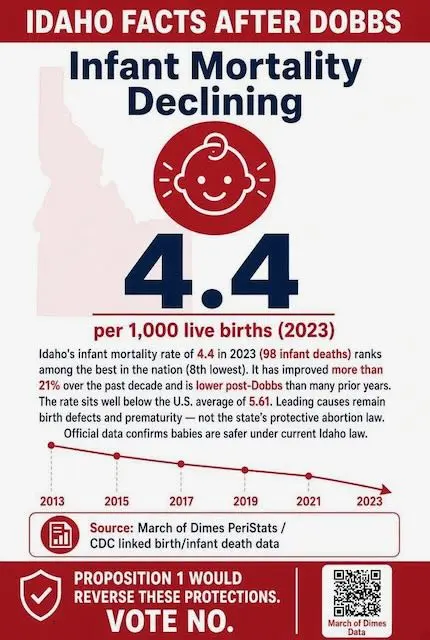
Infant Mortality: Among the Best in the Nation
4.4 per 1,000 live births, 2023
Idaho’s infant mortality rate was 4.4 per 1,000 live births in 2023 — 98 infant deaths — against a national rate of 5.6. That ranks Idaho 8th best of 52 reporting jurisdictions. Idaho also outperforms the nation on preterm birth (9.1% vs. 10.4%, a B- grade and 7th best), low-risk cesarean birth (20.1% vs. 26.6%), and first-trimester prenatal care (81.4% vs. 75.5%).
These are 2023 and 2024 figures — the first full years under Idaho’s current law, which took effect in August 2022. The leading causes of infant death in Idaho remain congenital anomalies and prematurity.
What this does and does not show. Idaho’s infant outcomes are strong and have not deteriorated under current law. We do not claim the law caused them. Different sources use different reporting windows — America’s Health Rankings, averaging 2022–2023, puts Idaho at 4.8 and 15th. Both figures are accurate; they measure different periods.
Source: March of Dimes 2025 Report Card for Idaho, drawn from CDC linked birth/infant death files.
Maternal Mortality: One Pregnancy-Related Death in 2024
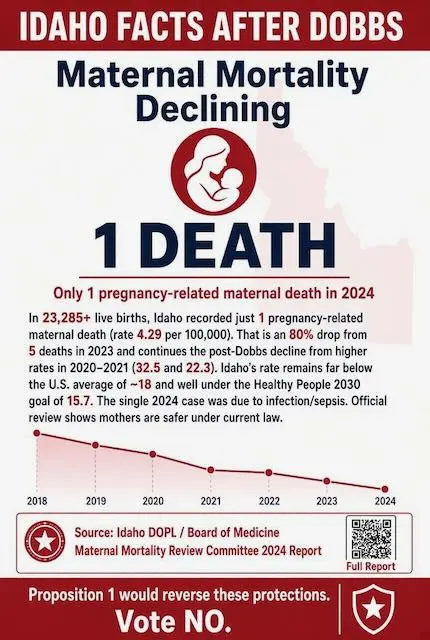
1 pregnancy-related death, 2024
The Idaho Maternal Mortality Review Committee’s 2024 annual report, approved January 27, 2026, found that among 23,285 live births, Idaho recorded 6 pregnancy-associated deaths, of which 1 was pregnancy-related. The resulting pregnancy-related mortality ratio was 4.29 per 100,000 live births, well under the Healthy People 2030 target of 15.7. The Committee described this as an 80% reduction in pregnancy-related deaths from the 5 recorded in 2023. The single 2024 case was attributed to infection or sepsis.
Pregnancy-related deaths by year: 9 in 2020, 9 in 2021, 2 in 2022, 5 in 2023, 1 in 2024.
Read the report’s own caution. The Committee states that its 2024 findings are “statistically insignificant due to the infrequency of maternal deaths compared to live births in the state” and that the report “should not serve as the only basis for changes to healthcare delivery or legislative initiatives.” We quote that in full because it cuts against overreading a single good year in either direction. The Committee also found all six 2024 pregnancy-associated deaths were somewhat or likely preventable, and recommended rural birthing-hospital support, better postpartum triage, and expanded maternal mental health resources. Those are real problems. Proposition 1 does not address any of them.
Source: Idaho MMRC Annual Report 2024 (PDF), Idaho Division of Occupational and Professional Licenses.
No Idaho Physician Has Been Criminally Prosecuted
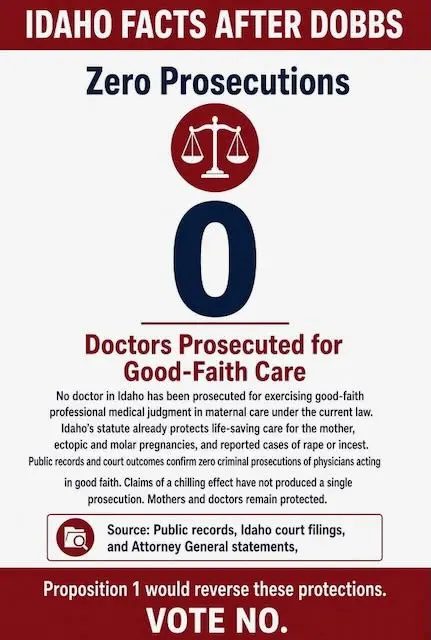
0 criminal prosecutions of physicians
Opponents of current law describe a “chilling effect” in which doctors fear prison for treating pregnancy complications. Four years into the Defense of Life Act, we are aware of no criminal prosecution of an Idaho physician for exercising good-faith medical judgment in maternal care.
The statute’s exceptions are exceptions, not affirmative defenses, and the life-of-the-mother standard turns on the physician’s own good-faith medical judgment rather than on certainty or imminence. Ectopic and molar pregnancy treatment is expressly outside the definition of abortion.
The full picture. Physicians have reported that legal uncertainty affects their practice even without prosecutions, and the civil-liability provision — family member suits with statutory damages of at least $20,000 — remains in force regardless of the criminal question. The August 13, 2026 federal ruling enjoining criminal enforcement in health-risk cases is on appeal. Voters weighing this should account for the litigation, not just the prosecution count.
Sources: Idaho Code § 18-622; Idaho court records; Office of the Attorney General.
The Physician Workforce: Contested Numbers, and What Proposition 1 Would Not Fix
You will hear two very different claims about Idaho’s obstetric workforce. Both come from real data, and they measure different things.
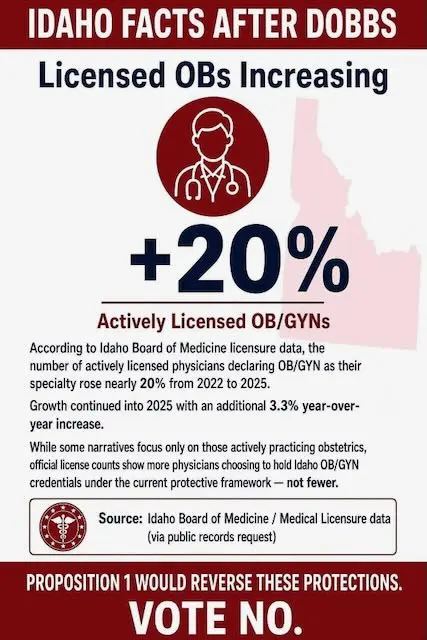
- Licensure counts. Idaho Board of Medicine records show physicians holding an active Idaho license who self-report OB/GYN as their specialty rose from roughly 280 in 2022 to just under 340 by 2024.
- Practicing-physician counts. A 2025 study published in JAMA Network Open, using credentialing files and direct verification, counted 94 of 264 practicing Idaho OB/GYNs leaving between August 2022 and December 2024 — a 35% decline.
The Idaho Division of Occupational and Professional Licenses has stated plainly that “an active license does not necessarily mean an individual is currently practicing.” Specialty is self-reported and not required, licenses renew on a two-year birthday cycle, and physicians commonly hold licenses in several states. We will not tell you the licensure figure proves Idaho has not lost obstetricians. It does not.
Here is what we will say. Idaho’s obstetric access problems are real, they are concentrated in rural counties, and they have causes that long predate 2022: hospital margins, Medicaid reimbursement rates, call coverage burdens in small communities, and a national obstetrician shortage that is squeezing states with no abortion restrictions at all. The Maternal Mortality Review Committee’s own legislative recommendation is rural hospital support for birthing care.
Proposition 1 does not build a labor and delivery unit, raise a reimbursement rate, or recruit a single physician to Pocatello, Malad, or American Falls. If access is the concern, the remedy is workforce and rural hospital policy — and that is work the Legislature can do in January, whatever happens in November.
Sources: Idaho Board of Medicine licensure data; Idaho DOPL; Idaho Capital Sun, August 12, 2026; JAMA Network Open, 2025.
Sources and Official Documents
Every claim on this page is linked to a primary source. We encourage you to read them.
- Ballotpedia: Idaho Proposition 1, Reproductive Freedom and Privacy Act Initiative (2026) — ballot title, full text, campaign finance, and arguments from both sides.
- Idaho Secretary of State: Initiative and Constitutional Amendment Information — the official filed text of the initiative.
- Idaho Maternal Mortality Review Committee Annual Report 2024 (PDF) — Idaho Division of Occupational and Professional Licenses.
- Idaho DOPL: Maternal Mortality Review Committee — all annual reports and summaries.
- March of Dimes 2025 Report Card for Idaho — infant mortality, preterm birth, prenatal care, and cesarean data.
- March of Dimes PeriStats: Idaho State Summary — underlying figures.
- Idaho Code § 18-622 — the Defense of Life Act as currently enacted.
- VoteIdaho.gov — registration, ballot requests, and polling locations.
Vote NO on Proposition 1
General Election — Tuesday, November 3, 2026